

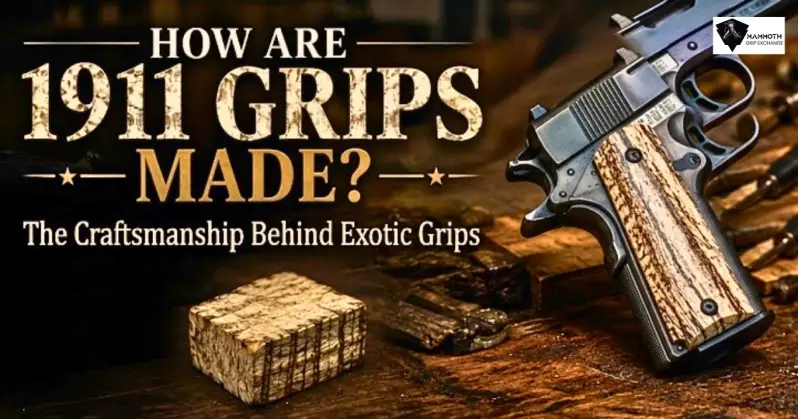
How Are 1911 Grips Made? The Craftsmanship Behind Exotic Grips
If you've ever held a finely crafted 1911 pistol and felt something different the moment your hand wrapped around the grip, you already understand that not all grips are created equal. For serious collectors and high-end firearm enthusiasts, the grip isn't an afterthought , it's the soul of the pistol. But how exactly are premium, exotic 1911 grips made? What separates a mass-produced plastic panel from a hand-finished piece of woolly mammoth ivory or fossilized dinosaur bone? Let's pull back the curtain on one of the most specialized crafts in the firearms world.
What Makes a 1911 Grip "Exotic"?
The term "exotic grip" refers to grip panels crafted from rare, naturally occurring, or unconventional materials , far beyond the standard rubber or synthetic options found on factory pistols. We're talking about materials like ancient woolly mammoth ivory (legally sourced, thousands of years old), fossilized dinosaur bone, stabilized burls, and hand-selected exotic hardwoods. These aren't novelty items. They are functional, precision-fitted accessories that transform a firearm into a collectible work of art.
Collectors and custom firearm owners seek out exotic 1911 grips for three core reasons: uniqueness, tactile quality, and investment value. No two pieces of mammoth ivory are identical. No two slabs of dinosaur bone share the same cell pattern. That inherent exclusivity is something no factory can replicate at scale.
The Materials That Define an Exotic Grip
Before a grip maker ever picks up a tool, the process begins with material sourcing , and this is where true expertise separates the craftsmen from the hobbyists.
Woolly Mammoth Ivory and Mammoth Molar
Mammoth ivory is harvested from permafrost deposits, primarily in Siberia and Alaska, where animals died naturally tens of thousands of years ago. It is 100% legal to own and trade in the United States, unlike elephant ivory. The crosscut patterns and natural mineral staining in mammoth ivory create colors and textures that simply cannot be manufactured. Mammoth molar, with its distinctive ridged "waffle" pattern, offers an entirely different visual profile , bold, tactile, and unmistakably prehistoric. You can explore these options firsthand at Mammoth Grip Exchange's mammoth ivory grips and mammoth molar grips.
Exotic Woods
From cocobolo and ironwood to stabilized maple burl and black palm, exotic wood 1911 grips offer warmth, grain complexity, and a connection to the natural world. Expert grip makers hand-select each blank for grain orientation, density, and figure. Stabilization , a process of infusing wood with resin under vacuum , is often used to prevent warping and cracking, critical for a material that will experience heat, oil, and mechanical stress over a firearm's lifetime.
Dinosaur Bone and Other Rare Materials
Fossilized dinosaur bone , also called "gembone" , is one of the most visually dramatic materials a grip maker can work with. The original bone structure is replaced over millions of years by silica and minerals, creating a mosaic of cells in vivid reds, blues, greens, and golds. Each piece is a literal fossil, making every grip a piece of natural history.
How Grips Are Shaped and Fitted
Once the material is selected, the real craftsmanship begins. Here's how a set of exotic 1911 grip panels goes from raw slab to finished product:
Blanking and Initial Shaping
The raw material is cut into a rough "blank" slightly larger than the finished grip dimensions. For fragile materials like mammoth ivory or dinosaur bone, this step requires precision cutting tools and a deep understanding of how the material behaves , grain direction, fracture points, and natural stress lines all factor in. A mistake here wastes irreplaceable material.
CNC Machining and Hand Finishing
Many premium grip makers use CNC (Computer Numerical Control) machining to achieve the initial contour , the precise 3D profile that fits a specific 1911 frame. However, CNC is only the beginning. The hand finishing process , sanding through progressively finer grits, smoothing edges, and final buffing , is where a craftsman's skill truly shows. On porous materials like mammoth molar or dinosaur bone, this stage can take hours per set.
Screw Hole Fitting and Bushing
Unlike rubber or G10 grips that flex slightly to accommodate minor variations, natural materials like ivory and fossil bone are rigid. The screw holes must be precisely placed and often fitted with custom bushings to distribute clamping force and prevent cracking. This is where amateur grip attempts frequently fail , and why experienced makers use proprietary methods developed over years of practice.
Anti-Warp Treatment and Stabilization
Natural materials move. Temperature changes, humidity shifts, and even the oils from your hands can cause subtle dimensional changes in untreated wood or bone. Premium makers , including those at Mammoth Grip Exchange , we use proprietary stabilization and sealing methods to minimize warping and ensure your grips maintain their fit and finish for decades.
The Role of Checkering and Texturing
Beyond shaping, many exotic grips incorporate checkering , a pattern of fine diamond-shaped cuts that improve purchase and add visual complexity. On hardwoods, checkering is cut with a specialized hand tool and requires significant skill to execute cleanly and consistently.
On materials like G10 or carbon fiber, texture is often machined or molded in. The choice of texture pattern is both functional and aesthetic, and it's one of the details that collectors notice immediately when handling a finished grip.
Modern Materials: Carbon Fiber, Damascus, and G10
Not every exotic grip comes from the natural world. Modern high-performance materials like carbon fiber, G10 fiberglass, and Damascus-patterned steel offer their own brand of craftsmanship , precision engineering, chemical resistance, and striking visual patterns achieved through layering and acid etching. These materials appeal to shooters who want durability and a tactical aesthetic alongside uniqueness.
Why Handcrafted Grips Outperform Factory Options
You might ask: can't a factory just produce these at scale? In short , no. The raw materials themselves prevent it. A fossilized mammoth tusk yields a finite number of usable blanks, each with a unique color gradient and mineral pattern. Scaling that process would require a supply that simply doesn't exist. Beyond material constraints, the hand-fitting process for a 1911 frame demands tactile judgment that machines cannot replicate. The result is a grip that fits better, feels better, and holds its value far longer than any production alternative.
Caring for Your Exotic 1911 Grips
Once you've invested in a set of handcrafted exotic grips, proper care ensures they'll last a lifetime , and beyond. Here's what we recommend:
- Natural ivory and bone: Wipe down with a lightly oiled cloth after handling. Avoid prolonged exposure to direct sunlight, which can bleach and dry out the material.
- Exotic wood: Periodic application of a food-safe oil (like tung oil or linseed) keeps the grain hydrated and vibrant.
- G10 and carbon fiber: These are virtually maintenance-free , wipe clean with a damp cloth.
- All materials: Store in a stable humidity environment. Extreme dryness is the most common cause of cracking in natural materials.
Where to Find Authentic Exotic 1911 Grips
The market for exotic gun grips is small and the quality varies significantly. When shopping for handcrafted 1911 grip panels, look for makers who source ethically and legally, offer transparency about their materials and process, back their work with a satisfaction guarantee, and have documented experience with natural materials like fossil ivory and dinosaur bone.
Mammoth Grip Exchange checks every one of these boxes. Our craftsmen work exclusively with legally sourced prehistoric and exotic materials, and every set ships with a 100% satisfaction guarantee. Whether you're looking for crosscut mammoth ivory, revolver grips, or AR-15 custom wood sets, the craftsmanship is built to last as long as the materials themselves , which, in the case of mammoth ivory, is already tens of thousands of years.
FAQs Related to How Are 1911 Grips Made
Are mammoth ivory gun grips legal in the United States?
Yes. Woolly mammoth ivory is completely legal to own, sell, and transport in the United States. Unlike African elephant ivory, which is regulated under the Endangered Species Act and CITES, mammoth ivory comes from an already-extinct species and is not subject to the same restrictions. Always purchase from a reputable dealer who can verify the material's origin.
How long does it take to make a custom exotic 1911 grip?
A handcrafted set of exotic grips typically takes anywhere from several days to several weeks depending on material complexity, finishing requirements, and whether custom inlays or checkering are involved. Rare materials like dinosaur gembone require especially careful work due to their natural brittleness and irreplaceability.
Will exotic grips fit any 1911 pistol?
Most exotic grip panels are made to fit standard Government-model 1911 frames, but variations exist for Officers, Commanders, and other frame sizes. Always confirm frame compatibility with your grip maker before ordering. Custom fitting services are available from specialized craftsmen who can tailor panels to specific frame dimensions.
Do exotic grips affect the function or accuracy of a 1911?
When properly fitted, exotic grips do not negatively affect function or accuracy , and many shooters find that a well-fitted grip actually improves their consistency by offering a more natural hand position. The key word is "properly fitted." Ill-fitting grips, regardless of material, can interfere with the magazine release or create pressure points that affect grip angle.
How do I know if an exotic grip is authentic?
Authentic exotic grips come with material documentation, clear photos of the actual piece you're purchasing (not a stock image), and are sold by makers with a verifiable track record. Natural materials like mammoth ivory and fossil bone will have unique, non-repeating patterns , if two grips look identical in every detail, something is off. Buy from established craftsmen like those at Mammoth Grip Exchange who stand behind their materials and craftsmanship with a satisfaction guarantee.
Add comment
Comments