

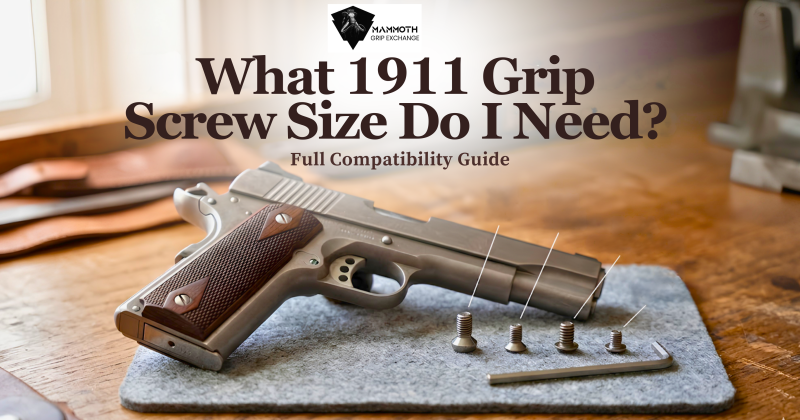
If you've just received a beautiful new set of 1911 grip panels — whether it's mammoth ivory, exotic hardwood, or dinosaur bone — the last thing you want is to discover you have the wrong grip screws sitting in your toolbox. It's a frustratingly common situation, and we hear about it regularly. That's why we put together this full compatibility guide: so you can get the right screw, install your grips correctly the first time, and never strip a bushing or crack a panel again.
Why Grip Screw Size Actually Matters
It might seem like a minor detail, but using the wrong grip screw size can cause real damage. Too short, and the screw won't fully engage the bushing — meaning your grips will shift under recoil. Too long, and you risk bottoming out against the frame before the grip panel is actually tight, or worse, cracking a brittle natural material like fossil bone or mammoth ivory.
On the other end of the spectrum, cross-threading a bushing in a quality 1911 frame is an expensive and avoidable mistake.
Our craftsmen at Mammoth Grip Exchange have seen all of these scenarios. When we build each set of our handcrafted exotic grips, we account for material thickness and screw engagement depth from the start — because a grip that's even a few thousandths off in panel thickness changes which screw length you need.
Standard 1911 Grip Screw Specifications
The vast majority of 1911 pistols — Government model, full-size frames made by Colt, Springfield Armory, Kimber, Rock Island, and most other manufacturers — use the same standard grip screw specification:
- Thread size: 5-40 UNC (Unified National Coarse)
- Head type: Flat head (slotted) or hex/Torx depending on screw style
- Standard screw length: Approximately 0.450″ to 0.500″ overall
- Bushing thread (female): Also 5-40 UNC, pressed into the frame
- Number of screws per pistol: 4 (two per side)
The 5-40 thread is the industry standard and has been since the original John Browning design. If you're buying replacement screws for a standard Government-model 1911, 5-40 UNC is what you need — full stop.
How Frame Size Affects Screw Compatibility
Here's where things get slightly more nuanced. While the thread spec stays the same across the 1911 platform, frame size does affect which screw length you need — and in some cases, which bushing design is used.
Government Model (Full-Size)
The standard Government-model 1911 with a 5-inch barrel uses the classic 5-40 screw and a standard-depth bushing. This is the most common configuration, and virtually every grip screw kit on the market is built around it. Our full-size 1911 grip panels are machined to Government-model frame dimensions unless otherwise specified.
Commander Model
The Commander (4.25″ barrel) shares the same full-size grip frame as the Government model. Grip screws, bushings, and grip panels are fully interchangeable between Commander and Government frames. If you're running a Commander, you don't need to do anything differently — our standard grips fit perfectly.
Officers Model (Compact)
The Officers model is where collectors frequently run into trouble. Officers-frame pistols have a shorter grip frame — roughly 3/4″ shorter than a Government frame — which means the grip panels themselves are smaller, and the screw hole positions are different. You cannot use Government-frame grips on an Officers-frame pistol. Always confirm your frame size before ordering. We offer compact-compatible options — reach out to our team directly and we'll make sure you get the right fit.
Double-Stack 1911 Frames
Double-stack 1911s (like the Para Ordnance or STI/Staccato platforms) have a wider frame to accommodate the higher-capacity magazine. The grip panels for these are wider and the screw spacing may differ. Standard single-stack grips will not fit a double-stack frame. This is one of the most common compatibility mistakes we see, and it's an easy one to avoid — just know your frame before you shop.
Understanding 1911 Grip Screw Bushings
The grip screw bushing is the threaded insert pressed into your 1911's frame that the grip screw threads into. Understanding bushing types is just as important as knowing your screw size.
Standard Bushings
Most production 1911s come with standard-depth bushings flush with or slightly below the frame surface. These work with standard-length 5-40 grip screws and are found on virtually every factory pistol.
Extended/Flush-Fit Bushings
Some custom builders and gunsmiths install extended bushings that protrude slightly from the frame. These are designed to allow for thicker grip panels — exactly the kind we produce at Mammoth Grip Exchange using materials like mammoth molar or exotic natural materials that may run slightly thicker than a factory rubber panel. If your grips are thicker than standard, you may need a longer screw or an extended bushing — our team can advise on this for any order.
Slotted vs. Hex Bushing Heads
Bushings themselves come in different head styles. The most common are:
- Slotted (flat-blade): Traditional look, found on most factory pistols
- Hex socket: Allows for more precise torque with an Allen key — preferred by gunsmiths
- Torx: Found on some higher-end custom builds; requires a specific bit size
Grip Panel Thickness and Screw Length: Getting It Right
This is the section most guides skip — and it's the one that matters most when you're installing premium exotic grips rather than factory rubber panels.
The formula is straightforward: screw length = grip panel thickness + bushing engagement depth. Standard factory rubber or G10 grips typically run 0.150″ to 0.180″ thick. Natural materials like mammoth ivory, crosscut mammoth ivory, or exotic hardwoods may be finished at 0.185″ to 0.220″ depending on the piece.
Here's a quick reference we use at Mammoth Grip Exchange:
| Grip Panel Thickness | Recommended Screw Length | Notes |
|---|---|---|
| 0.150"-0.170" | 0.450" overall | Standard Factory Replacement Thickness |
| 0.170" - 0.200" | 0.480" overall | Common for exotic wood and G10 |
| 0.200" - 0.220" | 0.500" - 0.520" overall | Natural Ivory, Fossile Bone, Thicker Naturals |
When you order a set of our handcrafted grips, we include recommended screw length guidance with every shipment — because we know the exact finished thickness of each panel we send out.
Common Mistakes When Installing 1911 Grip Screws
Even experienced collectors make these errors. Here's what our team sees most often — and how to avoid each one:
Over-Tightening
This is the number-one cause of cracked exotic grip panels. Natural materials like mammoth ivory and fossil dinosaur bone are rigid but not infinitely compressible. Tighten grip screws snug — not wrench-tight. Finger-tight plus a quarter turn is a good rule of thumb for natural materials. If your grips are shifting under recoil when properly snugged, the issue is usually screw length, not torque.
Using the Wrong Driver
A slotted grip screw requires a driver that fits the slot precisely — too narrow and it cams out, chewing up the head. We recommend a dedicated grip screw driver bit rather than a general flathead screwdriver. For hex or Torx screws, use the correct size key — don't approximate.
Ignoring Bushing Condition
Before installing new grips, check your frame's bushings. A worn or cross-threaded bushing will never hold a grip screw securely regardless of what you do. If a bushing spins or won't hold torque, replace it before installing your new panels — especially if those panels are irreplaceable exotic materials.
Not Accounting for Panel Thickness
As we covered above, using a standard-length screw on a thicker-than-normal panel means the screw bottoms out in the bushing before the grip is clamped. The grip will feel loose no matter how much you tighten it. This is especially relevant for our mammoth molar and exotic natural grips, which may run slightly thicker than a factory rubber panel.
Grip Screw Recommendations by Material Type
At Mammoth Grip Exchange, our grip lineup covers a wide range of materials, and each has slightly different installation considerations:
- Mammoth Ivory & Crosscut Mammoth Ivory: Use a longer screw (0.480″–0.500″) to account for thickness. Snug only — never wrench-tight. No thread-locking compound needed or recommended.
- Mammoth Molar: Same screw spec as ivory; slightly more surface variation means the panel should be test-fitted dry before final installation.
- Exotic Woods: Standard or slightly longer screws depending on the specific blank thickness. Wood grips can accept a slightly firmer torque than fossil materials.
- Carbon Fiber, G10, and Damascus: These modern materials are the most forgiving dimensionally. Standard 0.450″ screws work for most G10 and carbon fiber panels.
- Revolver Grips: Revolver grip attachment varies significantly by platform (S&W, Ruger, Colt) and does not use the 1911 5-40 standard. Contact us for specific guidance on revolver grip hardware.
AR-15 and Custom Wood Sets: A Different Standard Entirely
If you're shopping our AR-15 custom wood sets, the screw and fastener system is completely different from the 1911 platform. AR pistol grips use a single central bolt (typically a 1/4-28 screw) that threads into the lower receiver. Panel attachment — if applicable — varies by grip design. We include all necessary hardware and instructions with our AR-15 sets, so there's no guesswork on your end.
Our Recommendation: When in Doubt, Ask Us First
We've built Mammoth Grip Exchange on the principle that every customer should feel confident about what they're ordering and how to install it. If you're unsure about your frame size, bushing depth, panel thickness, or screw length, reach out to us before you order — not after. Our team has hands-on experience with every material in our catalog and can walk you through the right hardware selection for your specific pistol.
Every set of our grips ships with our 100% satisfaction guarantee. If something doesn't fit right, we make it right. Browse our full collection of handcrafted exotic 1911 grips and reach out any time — we're here to make sure your investment looks, fits, and functions exactly as it should.
FAQs About the What 1911 grip screw size do I need
What thread size are 1911 grip screws?
Standard 1911 grip screws use a 5-40 UNC (Unified National Coarse) thread. This applies to the vast majority of Government, Commander, and most compact 1911 frames from virtually every major manufacturer. If you're buying replacement grip screws for a standard 1911, 5-40 is the spec you need.
Are grip screws the same for all 1911 frame sizes?
The thread specification (5-40 UNC) is the same across Government and Commander frames, which share the same grip frame dimensions. Officers-model frames use smaller grip panels with different hole positioning, and double-stack frames are wider entirely. Always confirm your specific frame size before ordering grips or hardware.
Can I use a standard-length screw with exotic or thicker grip panels?
Not always. Exotic natural materials like mammoth ivory, fossil bone, and some hardwoods may be finished thicker than factory rubber panels. Using a too-short screw means it will bottom out in the bushing before the grip panel is clamped — causing the grip to feel loose. We recommend measuring your grip panel thickness and matching screw length accordingly, or contacting our team at Mammoth Grip Exchange for guidance specific to the panels you're ordering from us.
How tight should 1911 grip screws be?
For natural materials like ivory and fossil bone, snug is the goal — not wrench-tight. Finger-tight plus approximately a quarter turn is the right range. Over-torquing is the primary cause of cracked exotic grip panels, and it's an irreversible mistake on rare materials. For G10 and synthetic grips, you can apply slightly more torque, but even then, the screws don't need to be extremely tight.
Where can I find grips and screws that are already matched for compatibility?
At Mammoth Grip Exchange, we include screw length guidance with every grip set we ship, matched to the actual finished thickness of your specific panels. We handcraft each set individually, so we know exactly what hardware you'll need.
Add comment
Comments