

Dinosaur bone used on gun grips is fossilized prehistoric bone: genuine dinosaur skeletal material that has been mineralized over millions of years into a stone-like substance with vivid natural color and cellular pattern. It is one of the rarest and most visually striking materials available in the custom grip market. This guide explains what dinosaur bone actually is, how it forms, why it is used on firearm grips, and what buyers should know before purchasing.
What Is Dinosaur Bone?
Dinosaur bone, also called "dino bone" or gembone in the lapidary world, is the fossilized skeletal material of dinosaurs that lived between 65 and 230 million years ago. Over millions of years, the original organic bone material was gradually replaced by silica, calcite, and other minerals through a process called permineralization.
The result is a material that is structurally stone but retains the original cellular architecture of the bone. The haversian canals, lacunae, and osteon structures that made up living bone tissue are preserved in mineral form. This cellular pattern is what makes dinosaur bone visually unlike any other natural material and immediately recognizable to collectors.
Most dinosaur bone used in decorative and collector applications comes from the Morrison Formation in the American West, a geological deposit in Utah, Colorado, and Wyoming that contains abundant fossilized material from the Jurassic period. The material is legally collected under permit on private land and processed by lapidary artists into usable slabs for knife makers, grip makers, and jewelers.
What Makes Dinosaur Bone Visually Unique?
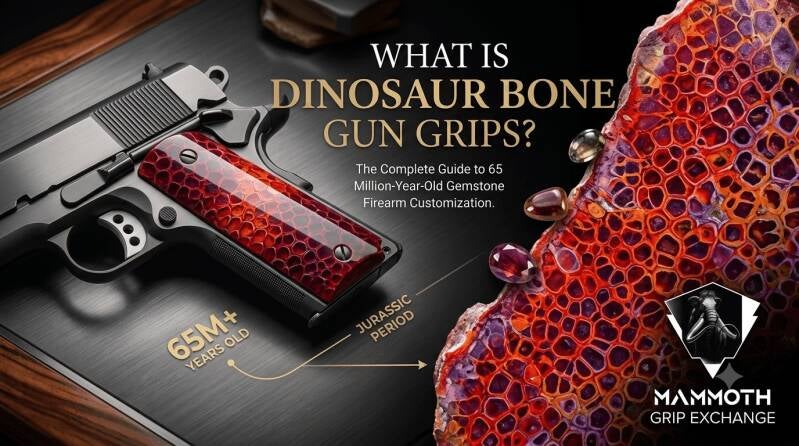
The defining visual characteristic of dinosaur bone is its cellular mosaic pattern, a natural grid of rounded cells separated by darker mineral matrix, creating an appearance similar to a honeycomb or stained glass window. Each cell represents a former osteon, the structural unit of living bone, now preserved in mineral form.
The color range is extraordinary. Depending on the specific minerals that replaced the original bone material, dinosaur bone can display deep reds, burnt oranges, yellows, greens, blues, purples, and near-black tones, sometimes multiple colors within a single piece. No two slabs are identical in color combination or cell density, making every dinosaur bone grip genuinely one of a kind.
The most prized coloration in the collector market is deep red-to-burgundy with high-contrast dark matrix. This combination produces the most vivid mosaic effect and photographs dramatically. Green and blue specimens are rarer and command a premium for their unusual coloration relative to typical fossilized material.
How Is Dinosaur Bone Formed?
Permineralization begins when a dinosaur's remains are buried in sediment before significant decomposition occurs. Groundwater carrying dissolved minerals, most commonly silica dioxide, iron oxide, and calcium carbonate, percolates through the sediment and into the porous spaces of the bone structure.
Over millions of years, these minerals precipitate out of solution and crystallize within the bone's cellular spaces, gradually replacing the organic material while preserving the bone's original architecture. The specific minerals present in the groundwater at the time of fossilization determine the final color of the bone: iron oxides produce reds and yellows, manganese produces purples and blacks, and silica alone produces translucent grey or white material.
The process requires specific geological conditions, including rapid burial, mineral-rich groundwater, and stable sediment, which is why well-preserved, colorful dinosaur bone is relatively rare even within productive fossil formations. Most fossilized material weathers out of the ground as grey or brown matrix-heavy fragments; the vivid multi-colored gem-quality material used in decorative applications represents a small fraction of what is recovered.
Why Is Dinosaur Bone Used on Gun Grips?
Compared to mammoth ivory, dinosaur bone is harder, more mineral-stable, and more dramatically patterned, but it lacks the smooth translucent warmth that makes ivory so valued for portrait scrimshaw and fine surface work. Mammoth ivory appeals to buyers who want elegant natural beauty; dinosaur bone appeals to buyers who want visual impact and prehistoric drama.
Against mammoth molar, dinosaur bone shares the cellular mosaic pattern aesthetic but differs significantly in color range. Mammoth molar produces blues, greens, and earth tones from its natural mineral content; dinosaur bone adds vivid reds, oranges, and purples to that palette, giving it a broader visual spectrum. Both materials are genuine fossils (mammoth molar from the Pleistocene epoch, dinosaur bone from the Mesozoic), but dinosaur bone is measurably older by tens of millions of years.
For collectors exploring the full range of fossil grip options, the natural comparison runs from mammoth molar grips through mammoth ivory grips and up to dinosaur bone, each representing a different geological era and a different aesthetic character within the fossil material category.
Is Dinosaur Bone Legal to Own and Use on Gun Grips?
Yes. Dinosaur bone collected from private land in the United States is entirely legal to own, buy, sell, and use in decorative applications including gun grips. Private landowners hold rights to fossils found on their property, and legally permitted collection operations in states like Utah and Colorado supply the lapidary and collector markets with compliant material.
Federal land is a different matter. Fossils collected from Bureau of Land Management or National Park Service land without permits are illegal to remove or sell, and material from those sources cannot be legally commercialized. Reputable suppliers of dinosaur bone grip material source exclusively from permitted private land operations and can provide documentation of provenance on request.
Buyers should always request sourcing documentation when purchasing dinosaur bone grips at significant price points. Legitimate suppliers welcome this request; reluctance to provide origin information is a meaningful red flag. The same due diligence that applies to verifying authentic mammoth ivory versus replica applies equally to confirming legally sourced dinosaur bone.
What Should You Look for When Buying Dinosaur Bone Gun Grips?
Color saturation and cell definition are the two primary quality markers. High-quality gem-grade dinosaur bone shows vivid, well-saturated color within clearly defined cellular boundaries. Lower-grade material shows faded, muddy color with poorly defined cell walls, often because the original bone was less dense or the fossilization process introduced excessive matrix material into the cellular spaces.
Surface polish matters significantly for grip applications. Dinosaur bone takes a high polish due to its mineral composition, and well-polished pieces show the cellular mosaic at maximum visual depth and clarity. Poorly polished material looks flat and fails to convey the full visual impact of the pattern. Examine grip photos in directional light, which reveals the surface quality more honestly than even, diffused photography.
Fit and finish at the attachment points, including screw holes, frame contact surfaces, and edges, should be as precise as any other premium grip material. Dinosaur bone is harder than organic materials and requires diamond tooling to shape and drill cleanly; rough or chipped edges at screw holes indicate inadequate tooling and can cause cracking under the stress of installation. Current dinosaur bone grip options at Mammoth Grip Exchange include the dinosaur bone grip 314, dinosaur bone grip 315, and dinosaur bone grip 495, each showing distinct coloration and cellular patterning.
How Do You Care for Dinosaur Bone Gun Grips?
Dinosaur bone is significantly lower maintenance than organic natural materials like ivory, wood, or antler. Because it is fully mineralized, it does not require conditioning, does not absorb gun oils or solvents, and does not respond to humidity the way organic materials do. Basic care is straightforward.
Clean dinosaur bone grips with a soft cloth dampened with clean water or a very mild soap solution. Avoid abrasive cloths or cleaning pads that could scratch the polished surface. The cellular walls between the mineral cells are slightly harder than the cell interiors in some specimens, making the surface mildly uneven at a microscopic level and more susceptible to surface scratch patterns than a perfectly uniform stone.
A light application of Renaissance Wax two to three times per year maintains the surface polish and provides a barrier against fingerprint oils and environmental contaminants. Unlike ivory or wood, dinosaur bone does not benefit from oil conditioning; mineral-stable materials do not dry out or crack from moisture loss the way organic materials do. For comparison on how organic fossil materials like mammoth ivory are maintained, the ivory care guidance illustrates how different the care requirements are between mineralized and organic fossil materials.
Is a Dinosaur Bone Gun Grip Worth the Investment?
The Short Answer
Yes. For collectors who want the rarest, most geologically ancient natural material available in the custom grip market, dinosaur bone is a clear and justifiable investment at its price point.
When Dinosaur Bone Is the Right Choice
Dinosaur bone suits collectors building a firearms presentation around maximum natural material impact, buyers who want grips that generate genuine conversation and recognition, and enthusiasts who have already explored mammoth ivory and molar and want to take their collection a step further. It also appeals strongly to buyers who want a completely maintenance-free exotic grip, with no conditioning, no humidity monitoring, and no seasonal care requirements.
When to Consider Other Materials Instead
If your priority is a smooth, warm surface ideal for scrimshaw artwork, mammoth ivory is the better canvas. Dinosaur bone's cellular texture and hardness make it less suitable for fine-line engraving. If budget is the primary constraint, exotic wood grips or carbon fiber and G10 grips deliver significant visual impact at a more accessible price point.
The Verdict
Dinosaur bone gun grips are not for every buyer. They are for the collector who understands what they are holding and wants a grip material with no equal in terms of geological age, natural pattern, and irreplaceable provenance. Every piece is a 65-million-year-old original. That is a statement no other material in the custom grip world can make.
Explore the full range of custom gun grips at Mammoth Grip Exchange, from fossil materials like dinosaur bone and mammoth ivory through exotic woods, Damascus steel, and scrimshaw, and find the grip material that fits your collection.
Add comment
Comments