

Displaying a 1911 pistol at home requires balancing presentation quality, firearm safety, and long-term material preservation. The right display setup protects the finish and grips from environmental damage while showcasing the firearm in a way that reflects the craftsmanship and value it represents. This guide covers every display format from basic stands through sealed collector cases, along with practical tips for protecting exotic grips and metal finishes over the long term.
Why Does Display Setup Matter for a 1911 Collection?
A poorly chosen display environment can cause more damage to a fine 1911 than years of careful use. Ultraviolet light fades exotic wood grips and discolors ivory. Humidity fluctuations cause wood grips to expand and contract, potentially cracking finish or loosening grip screws over time. Dust accumulation in open displays creates an abrasive layer that micro-scratches polished surfaces with every handling.
Display setup also communicates the seriousness of the collection. A $3,000 pistol with custom mammoth ivory grips sitting on a foam pad on a shelf reads differently than the same firearm mounted on a fitted hardwood stand inside a sealed glass display case. The display is the frame for the artwork, and the quality of one reflects directly on the perceived quality of the other.
For collectors who have invested in custom exotic grips, the display decision is an extension of that investment. The grip material, the firearm's finish, and the display environment work together as a complete presentation. Getting all three right is what separates a collector's display from a storage arrangement.
What Are the Main Types of 1911 Display Stands?
Display stands for 1911 pistols fall into four main categories: single-gun stands, open tray range stands, multi-gun display systems, and custom-fitted mounts. Each serves a different purpose and suits different display contexts from casual home display through serious collector presentation.
Single-gun stands hold one pistol upright or at a displayed angle and are the most common starting point for collectors displaying a featured piece. They work well on bookshelves, mantels, and display cabinets where the pistol is the focal point of the space. Open-tray range stands hold the pistol horizontally in a shallow cradle, showing the full profile of the firearm with maximum visibility from above and the sides.
Multi-gun systems allow collectors to display several pistols in a coordinated arrangement, which suits collections where the relationship between multiple firearms is part of the story being told. Custom-fitted mounts, which anchor the pistol at specific frame points, provide the most secure and precisely positioned display but require more planning and investment than off-the-shelf stand options.
What Should You Look for in a 1911 Display Stand?
The contact points between the stand and the firearm are the most critical quality factor. Any surface that touches the pistol's finish or grips should be covered with a non-abrasive, non-reactive material: felt, suede, or soft foam. Hard plastic or bare wood contact points will scratch blued steel and polish-finished grips over time, regardless of how carefully the pistol is placed and removed.
Stand stability matters more than it might seem. A light stand that rocks or tips easily creates a risk of the pistol falling, which can chip exotic grip materials, dent the frame, or damage the sights. The stand's base weight and footprint should be proportional to the firearm's weight and the typical handling traffic in the display environment.
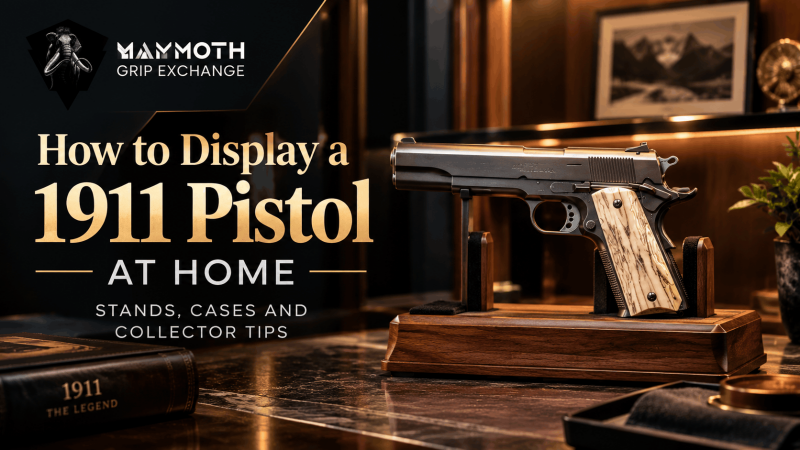
Material and finish of the stand itself contributes to the overall display quality. A raw-wood or plastic stand under a custom 1911 with mammoth ivory grips creates a visual mismatch that undermines the presentation. Stands finished in hardwood, metal, or quality leather-wrapped wood present at a level appropriate to fine custom firearms. Mammoth Grip Exchange offers a full range of purpose-built display options including the standard single gun stand, open tray range stand, and open tray grand stand for collectors who want display hardware that matches the quality of their firearms.
How Do You Display a 1911 in a Glass Case or Display Cabinet?
A sealed or semi-sealed glass display case offers the best protection for a fine 1911 because it controls the immediate environment around the firearm. Dust, airborne moisture, and UV light are the three primary environmental threats to both metal finishes and exotic grip materials, and a quality glass case addresses all three simultaneously.
Choose a case with UV-filtering glass or acrylic panels if the display location receives any natural light. Standard glass transmits UV freely, and even indirect natural light exposure over months and years causes measurable fading in exotic wood grips and gradual yellowing in ivory-family materials. UV-filtering panels are a modest upgrade that pays dividends in material preservation over a long-term display.
The interior of the case should be lined with acid-free, non-off-gassing material. Many mass-market display cases use foam or fabric liners that contain volatile compounds that can react with metal finishes over time, causing subtle surface discoloration. Museum-quality cases use chemically inert liners; for home use, acid-free foam covered with natural fabric is a practical and accessible alternative.
Where Should You Position a 1911 Display at Home?
Position matters as much as display hardware for long-term preservation. The worst display locations for a fine 1911 are above or near heating and cooling vents, on walls that receive direct sunlight at any time of day, in rooms with high humidity variation such as bathrooms or kitchens, and in high-traffic areas where the display will be bumped or dusted frequently.
The best display locations are on interior walls away from windows, in rooms with relatively stable temperature and humidity year-round, and at eye level or slightly below so the firearm can be appreciated without requiring awkward viewing angles. A dedicated display room or office space provides far more control over environmental conditions than a living room or entryway.
If the display location receives any direct or strong ambient light, consider supplementing with targeted LED display lighting rather than relying on ambient room lighting. Low-heat LED strip lights inside a display case or directed at a stand-mounted pistol illuminate the firearm's finish and grip materials dramatically while generating minimal UV or heat compared to incandescent or halogen alternatives.
How Do You Protect Exotic Grips in a Home Display?
Exotic grip materials each have specific vulnerabilities in display environments. Mammoth ivory and fossil materials are sensitive to rapid humidity changes, which cause expansion and contraction cycles that can eventually crack even well-mineralized material. Exotic woods are similarly sensitive to humidity but also to UV fading, which shifts warm-toned woods toward grey or washed-out tones over years of light exposure.
For displayed pistols with exotic grips, maintain the room's relative humidity between 45 and 55 percent year-round. A small silica gel packet inside a sealed display case stabilizes the immediate environment without requiring whole-room humidity control. Replace or regenerate silica gel packets every six to twelve months to maintain their effectiveness.
Condition exotic grip materials before placing the pistol in long-term display and on a maintenance schedule thereafter. A lightly conditioned grip resists environmental stress better than a dry one. The ivory care guidance at Mammoth Grip Exchange covers specific conditioning protocols for fossil materials, and the same principles of light conditioning and environmental control apply across exotic wood and natural bone grip materials. General maintenance best practices are also covered in the top maintenance tips for exotic wood and fossil grips.
How Do You Display Multiple 1911 Pistols as a Collection?
Multi-pistol display requires a framework that communicates the collection's internal logic. Collections displayed without clear visual organization read as accumulation rather than curation. The most effective multi-gun displays organize firearms by a consistent principle: chronological production order, caliber progression, grip material category, or manufacturer history.
Open tray display systems that hold multiple pistols in a unified frame work well for collections of three to six firearms where the relationship between the guns is part of the story. The open tray stand format allows multiple 1911s to be displayed side by side with consistent height and angle, creating a coordinated presentation that individual stands cannot achieve.
For larger collections, a dedicated display cabinet with adjustable shelving allows the collector to configure height and spacing as the collection evolves. Building in lighting, humidity control, and lockable glass from the start is significantly more cost-effective than retrofitting these features later. Plan for the collection you intend to build, not just the one you have today.
What Are the Safety Considerations for Home Display of a 1911?
Any firearm on display in a home must be secured against unauthorized access, particularly if children or visitors are present. The display format should never compromise firearm security in favor of aesthetic presentation. A beautiful open display that an unauthorized person can reach and handle is not an appropriate display regardless of its visual quality.
Locking display cases are the standard solution for collector firearms that need to be visible but secured. For higher-value collections, consider cases with tamper-resistant hardware and key or combination locking mechanisms rather than basic cabinet latches. The display case is both a presentation tool and a security device, and it should perform both functions adequately.
Displayed firearms in the home should be stored unloaded, with any stored ammunition kept separately and secured independently. This is both a safety best practice and, in many jurisdictions, a legal requirement for firearms accessible to minors. Compliance with local storage laws is a baseline requirement that should be confirmed before establishing any home display of firearms.
How Do You Elevate a 1911 Display from Storage to Showcase?
The difference between a storage arrangement and a genuine showcase display is attention to the details that communicate intentionality. A showcase display positions the firearm at the correct angle for the viewer's natural sightline, uses lighting that reveals rather than flattens the finish and grip texture, and presents the pistol in context with accessories or documentation that tell a complete story.
Consider pairing a displayed 1911 with period-appropriate accessories: a fitted leather holster, a spare magazine on a dedicated magazine holder, or a framed photograph of the firearm's provenance. The vintage gun leather accessories available at Mammoth Grip Exchange pair naturally with 1911 display presentations, adding historical depth and visual interest beyond the pistol alone.
If the pistol has custom exotic grips, display a small card or label identifying the grip material, its origin, and any relevant details. This is standard practice in museum-quality displays and serves the same function in a private collection: it contextualizes the material for viewers and communicates the collector's knowledge and intentionality. A 1911 with a card reading "Siberian Woolly Mammoth Ivory Tusk Grips" tells a story that the grip alone, however beautiful, cannot tell unassisted.
What Display Accessories Complete a 1911 Collector Setup?
Beyond stands and cases, a complete 1911 display benefits from magazine holders that present spare magazines alongside the pistol, lighting that illuminates the full profile of the firearm, and surface protection for the display area itself. Magazine display accessories like the 1911 gun mag pegs allow spare magazines to be displayed vertically alongside the pistol in a coordinated arrangement that completes the presentation.
The Bullet Buddy pistol display offers another option for collectors who want a combined pistol and ammunition display format that presents the complete firearm system rather than the pistol alone. These accessory display options transform a single-gun presentation into a complete collector tableau.
Surface protection under the display stand matters too. Felt pads under stand feet protect furniture surfaces, and a display mat or tray under the entire arrangement catches any oils or residue from the stand or pistol while giving the display area a finished, intentional appearance. Small details like these separate a collector-grade display from a casual shelf arrangement.
Is Investing in a Quality Display Setup Worth It?
The Short Answer
Yes. The display environment directly affects the long-term condition, value, and presentation quality of a fine 1911. Underinvesting in display relative to the firearm's value is one of the most common and costly mistakes collectors make.
For Occasional Display and Home Enjoyment
A quality single-gun stand with proper felt contact points, positioned away from light and heat sources, is adequate for most home display situations. Add a small silica gel packet nearby if the room humidity varies significantly across seasons, and condition exotic grip materials on a regular schedule regardless of display frequency.
For Serious Collector and Showcase Display
Invest in a sealed glass case with UV-filtering panels, interior LED lighting, and humidity-control provisions from the start. The cost of a quality display case is modest relative to the value of a fine custom 1911, and the protection it provides justifies the investment many times over compared to the cost of refinishing a damaged finish or replacing cracked exotic grips.
The Verdict
A 1911 pistol with custom exotic grips deserves a display environment that matches its craftsmanship. The stand, the case, the lighting, and the positioning are all part of the presentation, and each element either adds to or subtracts from the total impact of what is being shown. Get the display right and the firearm will look and remain at its best for decades. Neglect it and even the finest custom pistol will eventually show the consequences.
Explore the full range of gun display stands at Mammoth Grip Exchange, and browse the complete custom gun grips collection to build a 1911 presentation worthy of the display it deserves.
Add comment
Comments